AI for peace in Kenya starts with people
Practical training, careful verification and human judgement can help people navigate uncertain information. Sparks Amani explores how to bring that work together.
An important technology question goes beyond what AI can generate: can it help people find evidence, understand one another and respond responsibly when information is uncertain?
That is the question behind Sparks Amani, a Sixsparks concept connecting practical training, human-led verification and community response. A convincing answer will come from useful tools in the hands of people who understand the communities they serve.
A forwarded message needs more than a confident answer
Imagine receiving a photograph described as evidence of an incident happening today. The caption is urgent, but you cannot tell where it originated, whether the date is correct or what happened before the camera started recording. An AI assistant can produce an explanation in seconds. That does not mean it has established what happened.
Where did the image first appear? Is there an original publication? Does the location match? Are independent sources reporting the same event? What remains unknown? AI can help organise that work, but a trained person must assess the sources and take responsibility for the response. Sometimes the responsible answer is that there is not enough evidence yet.
Kenya already has people doing this work
Digital peacebuilding does not begin with our concept. Kenya has civic organisations, journalists, educators and peace practitioners with relevant experience. Ushahidi's account of Uchaguzi describes a workflow connecting citizen reports with verification and response. Collecting information is only the beginning; somebody must check it, understand its context and decide what to do next. [1]
A peace-oriented system must protect space for criticism, disagreement, satire and peaceful organising. The opportunity for AI is to strengthen human infrastructure, not replace it or monitor everyone more closely.
Start with training that changes practice
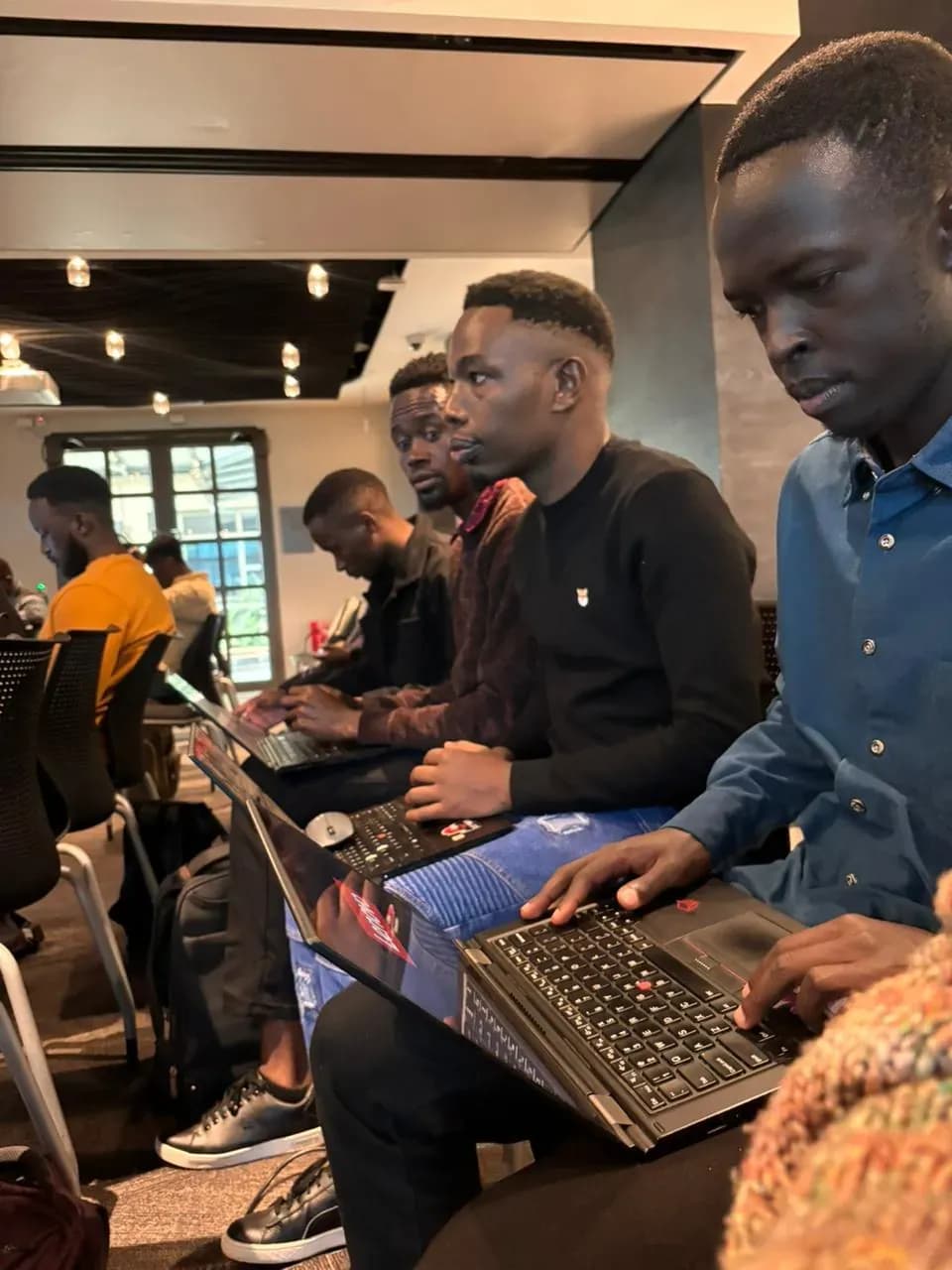
Our team's training experience spans university sessions, including Moi University, hackathons, Localhost events and Ujuzi Hub. The training pictured here was under Ujuzi Hub, with McoChieng Labs and the Kenya Microsoft Fabric Community. People learn technology by working through problems, asking questions and seeing its limitations as well as its possibilities.
An AI-for-peace programme should teach more than prompting. Participants should practise finding original sources, checking dates, recognising recycled photographs and explaining uncertainty without amplifying a rumour. UNESCO's research on digital creators in Kenya reinforces the need for media and information literacy and verification skills. [2]
A useful session should leave participants able to demonstrate a better verification process. Exercises before and after training, followed by a later check, can help assess learning. Attendance alone is not the same as improved capability.
Local languages need local judgement
Information travels through Swahili, local languages, code-switching, humour and phrases whose meaning depends on the setting. Sixsparks' Shiriki work involving Swahili, Dholuo and Gikuyu gives us a relevant engineering foundation. It does not remove the need to evaluate peace-related tasks with qualified speakers.
Translation must remain reviewable. A phrase quoted to challenge prejudice must not be mistaken for an endorsement. A system must not infer ethnicity or political beliefs from someone's language.
Turn questions into an accountable evidence trail
The Sparks Amani workflow connects training, evidence gathering, human verification and community response. A private evidence workbench could bring together source links, dates, supporting material, contradictory information and open questions. An authorised reviewer would approve an explanation, request further checking or record that evidence remains insufficient.
A public response would show what was checked, when it was reviewed and how to request a correction. The platform would not be an emergency dispatcher, automated censorship service or a system for accusing individuals. Private reports would remain separate from marketing leads and model-training datasets.
Demonstrate usefulness before claiming impact
A bounded pilot would need agreed partners and trained reviewers, as well as legal, staffing and operational readiness. It could assess verification skills, valid-source use, appropriate uncertainty, corrections and reviewer effort.
We would not call report volumes proof of peace or promise that a model can prevent violence. Sparks Amani is a concept informed by real experience, not a completed peace deployment.
Sources
These sources provide context for the article and the Sparks Amani concept.
- Uchaguzi platform empowers citizen participation — Ushahidi. An account of reporting, verification and response.
- The context and challenges of digital content creation in Kenya — UNESCO. Research on digital creators and media and information literacy.
Training in practice
Learning together.
A look at the practical training experience that informs our approach.
A next step
Working on something similar?
Explore the case study behind this approach to practical training and accountable verification.